
Our Universe Might Be Inside A Black Hole
What if the Big Bang was actually a black hole in another universe? We dive into the history and modern revival of the “universe inside a black hole” hypothesis from Einstein and wormholes to the latest 2025 research.
SCIENCE


So, I’m back in therapy (again). And during one of the sessions, I told my therapist I’d been feeling this weird persistent void in my life, like everything is collapsing inward. He nodded and said: “You might be onto something. If some physicists are right, we’re all living inside a black hole.” Then he scribbled something in his notes, probably “existential crisis.”
Excuse me, we’re...WHAT NOW?!
It started with me clicking on one physics video. Just one teeny-tiny video. Suddenly it’s 3AM and I’m googling “black hole childbirth” and “foamy spacetime.” Galaxies are also apparently doing synchronized dances around the universe, because of course they are. Why wouldn’t they?! Who am I to stop their artistic expression?! I am but an overcaffeinated IDIOT who thought, “Oh wow, this will make a fun little article!”
Cut to me, three weeks later, screaming into the aforementioned void, still trying to understand torsion.
That’s definitely something I’ll have to unpack in my next therapy session. But for now...You’re coming with me! I’ve been cursed with this knowledge, and now so must you be.
So, buckle up because we’re about to review the whole history of how the “black hole universe” idea came to be, as well as the new papers published this year that support it.
The History of the Idea
Einstein Drops General Relativity and Everything Gets Weird
As it turns out spacetime is stupid curvy. And the first scientist to really linger on those curves was Albert Einstein. He was like “If the universe is gonna be voluptuous, we gotta have the math to measure that thing!” His field equations describe how: spacetime bends, stretches, twists, how volumes change, how light paths and time flow are affected and how matter and energy play a role in all of it.[1]
In a nutshell these equations say that matter and energy curve spacetime, and that curvature is what we experience as gravity.
When physicists started actually solving these equations, they discovered two strange possibilities: expanding universes[2] and stars collapsing into black holes[3]. Ahh yes, the two moods of the cosmos: I’m growing. I’m dying. Relatable.
These solutions had a singular thing in common called...the singularity. That’s the point where density and curvature go to infinity and physics pretty much breaks down, or so the physicists thought. “And if singularities appear in both black holes and the Big Bang, maybe they’re the same kind of thing, we just need to see it from a different perspective, man.” said some physicist on shrooms, probably. “No, no, he’s got a point” said some other physicists and this is how the black-hole-universe idea began.
Physicists Discover Singularities and Immediately Regret It...
In the 1960s, Penrose and Hawking proved a set of theorems showing that if you follow classical relativity all the way down, you inevitably end up with singularities both in black holes and the Big Bang.[4]
“Okay but what actually happens in a singularity?” asked a physicist.
As I said, physics breaks down.
“Right...right...but what actually happens though? You know what I mean?”
As I said, it’s impossible to know.
“Mmhm. I hear you. I respect you. BUT WHAT HAPPAN?!”
Shhhh!
“WHAT HAPPAN?!”
You’ll activate the others!
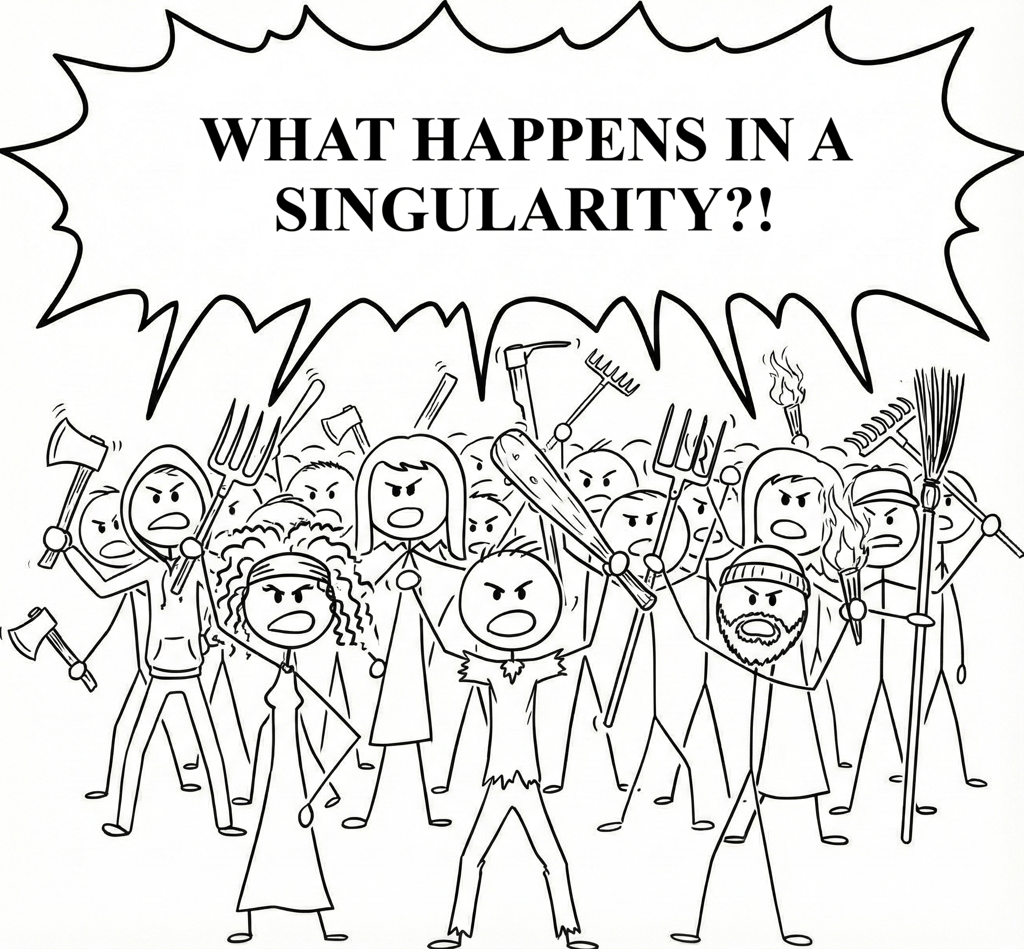
It’s too late now. Physicists, being difficult and not in the habit of shrugging things off, started speculating that maybe the inside of a black hole leads to a new region of spacetime.
Now this wasn’t a totally random idea. It was based on a mathematical solution Einstein and Rosen found where a black hole could connect two spacetime regions, a black hole and a white hole (the time-reversed version that yeets matter outward).[5] Now, is anyone here surprised that Einstein, who spent his career looking into spacetime curves, was also interested in connecting black holes and white holes?
The only problem with this solution though, is that the “bridge” connecting these holes collapses quicker than the bridge connecting me and my will to live, which means it’s not traversable. BUT this introduced the concept of black hole-white hole duality and led to speculation that the Big Bang might have been a white hole event aka. an “outflow” from a black hole in another universe.
Universes Start Breeding: The First Baby Universes
Several physicists developed early versions of this idea independently. Igor Novikov proposed that when a star collapses into a black hole, the collapse doesn’t end in a singularity. Instead, the extreme curvature could create a new region of spacetime, a new universe, with the event horizon acting as the boundary between parent and offspring universes.
“Parent and offspring? Write that down! Write that down!” said John Wheeler, who quite liked this idea of parent-child dynamics within black holes. He speculated that the fabric of spacetime could be “foamy” at ultra-small scales and that this “quantum foam” could form tiny closed-off pockets of spacetime, which he called “baby universes.” And just like actual babies, these things are unbelievably fragile. They either collapse immediately, or grow into full-sized universes if conditions are right[6]. And just like most human babies through history most of them...“collapse immediately”.
“Well, that looks an awful lot like Darwin’s theory, the survival of the fittest” said Lee Smolin, probably, who came up with the “Cosmological Natural Selection” theory: every black hole spawns a new universe with slightly different physical constants, forming an evolutionary “tree of universes.” Universes “reproduce” through black holes, and those that produce more black holes have more “offspring.”[7]
At this point physicists were basically competing to see who could propose the most unhinged idea and plagiarize biology the hardest. Seriously, for the last time, black holes are NOT wombs!
Stop Asking About Singularities!
But even the wildest ideas hit the same wall: classical relativity predicts singularities, while quantum physics doesn’t allow infinities. So, now those same physicists who were so eager to figure out how singularities work wanted them to just...be gone, not exist. It’s kind of like when you break up with someone you were very infatuated by.
Hey! You! You, who were shouting “WHAT HAPPAN?!”, what happen to your singularity?!
“I have no idea what you’re talking about...”
Cue the entrance of the quantum-gravity contenders, each promising to rescue the universe from its awkward infinite-density:
In Loop Quantum Cosmology spacetime has the smallest possible unit and cannot be squished past that point. When you try to squish the universe to insanely high densities, as one does, quantum geometry makes gravity turn repulsive. This prevents collapse to a singularity and instead the universe bounces and falls out of your hands. So, just don’t squish the universe. It’s not worth it.[8]
In Einstein–Cartan Theory particles have spin that twists spacetime (creating torsion). Now physics students, would you care to explain to the whole class what spin is? (This might be a joke only physicists will appreciate) We’ll define spin as a particle’s intrinsic angular momentum. Normally this torsion is tiny, but when matter becomes ultra dense, the spin effects grow huge which creates a strong repulsive force.[9]
So again, you try to squish the universe, despite what I said earlier and again you cannot do it and it bounces out of your hands creating a new expanding region of spacetime. However, the difference is that this time this all happens inside the event horizon.
To someone inside the black hole, the bounce would look like a Big Bang, to someone outside, it would look like a regular black hole. In this view, every black hole could give rise to a new universe. And our own universe might be the interior of a black hole in another universe. Polish-American physicist Nikodem Popławski revitalized and popularized this idea with a series of papers (2010–2025). Remember that name because we’ll discuss one of these papers shortly.
All of this brings us to today, where physicists are still trying to figure out where these ideas ultimately lead. And with a new generation of models and papers, the search has only gotten more interesting.
Fun fact: This article took me an embarrassingly long time to put together. Look, I’m no physicist, okay? So if you want to encourage more of these in depth pieces, or you just enjoy watching me suffer, consider subscribing to the newsletter. It’s completely free, but it means a lot to me :)
Subscribe to the newsletter
Get updates on new posts, projects, and occasional thoughts and reflections! Basically, whatever's on my mind straight to your inbox.
Arguments, counterarguments and new research
The distribution of galaxy rotation in JWST Advanced Deep Extragalactic Survey (2025)
Lior Shamir https://doi.org/10.1093/mnras/staf292
Oh wow! A paper by a sole researcher in the year of our Lord 2025! Now this must be extraordinary work. There was initially a lot of praise for this paper, from what I’ve seen. So, let’s see what it actually says.
👏 PAPER 👏 REVIEW 👏
(Clack your dentures if you recognize this reference)
According to the paper, the researchers...sorry, force of habit, the researchER examined 263 galaxies in the GOODS-S field. That means super old, distant galaxies that existed when the Universe was but an infant. He determined each galaxy’s rotation direction and found that about 60% of them spin in the opposite direction.
That’s kinda weird because under the standard cosmological principle, once you zoom out far enough, the Universe should look the same in every direction. We should be seeing roughly equal numbers of clockwise and counterclockwise rotations no matter where we look.
If this asymmetry is real, it could support cosmological models in which the Universe has a preferred direction, a cosmic-scale axis. And in frameworks where our Universe is the interior of a spinning black hole, a cosmic spin axis would naturally emerge because black holes themselves possess angular momentum.
Now hang on a second...


...


Did this dude just...
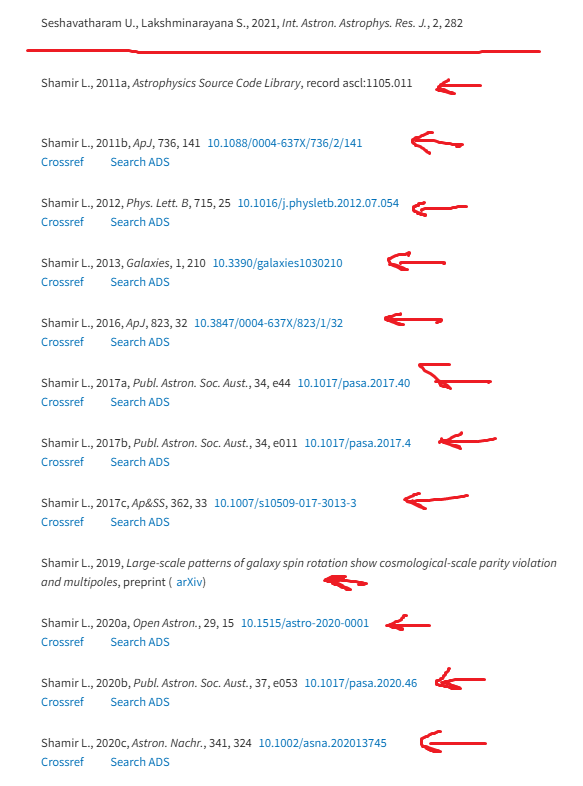




Holy Moly! Sir, this is a science paper, not an autobiography. Bro cited himself 27 times! Way to boost your h-index!
Also, critiquing Iye and Sugai’s (1991) study for using a small sample of 6,525 galaxies is certainly a bold move for someone who only analyzed 263. I mean, we’ve taken pictures of tens of millions of galaxies at this point, out of the roughly 2 trillion in the observable universe. This is like roasting someone for bringing a small salad to a potluck while you show up with three croutons in a napkin. Potluck aside, you simply can’t make inferences about cosmic rotation from a sample that size with just a 60% imbalance. Meanwhile, other studies with far larger and more spread-out galaxy samples haven’t found anything resembling this effect.
For example, in 2021 paper by Iye, Yagi & Fukumoto “Spin parity of spiral galaxies. III. Dipole analysis of the distribution of SDSS spirals with 3D random walk simulations” they looked at a huge catalog of spiral galaxies from the Sloan Digital Sky Survey to see whether more galaxies spin one way than the other. At first, the catalog seemed to show over 160,000 spirals, but when the authors cleaned up the data and removed duplicates and questionable entries, the real number of usable galaxies dropped to about 48,000. When they analyzed this cleaner set, 23,819 galaxies were rotating one way and 24,270 the opposite way. In other words, the difference was tiny and well within what you’d expect from random chance.[10]
In another paper aptly named “No evidence for anisotropy in galaxy spin directions” (Patel & Desmond, 2024) the authors collected all publicly available data sets where galaxies’ spin direction has been classified. So, they pretty much examined hundreds of thousands of galaxies across the datasets. The results: the spins still look random.[11]
So yeah, I give Shamir’s paper 263/2 trillion, which he must admit is a pretty big number.
👏 NEXT 👏 PAPER 👏
Universe in a rotating black hole and preferred axis (2025)
Nikodem Popławski https://doi.org/10.48550/arXiv.1910.10819
Another one-man paper. Someone, please tell physicists they’re supposed to cooperate. They write papers by themselves, cite mostly themselves...But, let’s see...
So, this paper basically explains how Black Hole Cosmology (BHC) elegantly solves a bunch of issues in physics and how it’s supported by certain experimental evidence.
Black Hole Cosmology (BHC) and the Absolute Frame of Reference (AFR)
One of these issues is the long-standing problem of how to define “true motion” or “absolute space” if there’s nothing else around to measure against. Put simply, how do we know something is rotating if there’s nothing else in the universe to compare it to? What is it rotating relative to?
Newton and Einstein both argued that “true motion” can’t be defined only in relation to other objects. It must be referenced to something absolute. Einstein framed this in terms of a field (the metric tensor). But according to Mach’s principle, even this should be determined by distant matter. So, if there is no distant matter, what defines the metric, rest or inertia?
BHC offers an answer:
The original parent black hole, appearing in our universe as a primordial white hole, acts as the “anchor point” for the entire universe. The frame of reference in which this white hole is at rest becomes the Absolute Frame of Reference (AFR). “At rest” here doesn’t mean non-rotating or motionless, it means only that the white hole is not moving through space but is instead being stretched apart by cosmic expansion like everything else. This Absolute Frame of Reference defines concepts such as absolute time, simultaneity, and comoving distances.
The white hole here effectively replaces the “distant matter” required by Mach’s principle, making general relativity fully “Machian.” The paper also suggests that, in this AFR, the cosmic microwave background should naturally appear smooth and uniform on the largest scales. (Convenient)
Black Hole Cosmology also provides a natural explanation for why time flows forward rather than both ways. In a black hole, matter can cross the event horizon only one way, you cannot go back out. That one-way flow defines a direction of time. This cosmic arrow of time is inherited by the baby universe. And because entropy increases inside the expanding universe, the thermodynamic arrow of time aligns with the cosmic arrow. Everything flows in the same direction: gravity, causality, and entropy all point “forward.”
Avoiding Singularities and Explaining Inflation
Black Hole Cosmology uses the Einstein–Cartan theory to say that torsion makes things bounce outward before singularities ever happen. We’ve been over this.
But what happens right after this bounce? According to Popławski, the quantum effects in the strong gravitational field make a loooot of particles. This combined with torsion pushing everything away naturally drives a period of rapid expansion aka. inflation. The key point is that this inflation doesn’t require summoning any mysterious new fields with oddly specific potentials. It’s just torsion + gravitational particle production, both standard, already-existing physics while other inflation theories make one ask “Are these fields in the room with us right now?”
The Consequences of Rotation: Preferred Axis and Cosmic Motions
Most black holes rotate, and a universe born inside one would inherit that rotation, giving it a preferred axis, a kind of built-in cosmic direction. Large structures like galaxies would naturally tend to align their spins with this inherited rotation because that’s the lowest-energy arrangement. And in physics, if something can save energy, it does so. Kind of like people. Galaxies don’t like doing more than they have to either.
This leads to a logical prediction: the number of galaxies spinning clockwise should differ from the number spinning counterclockwise. And indeed, multiple independent analyses have found this exact kind of asymmetry.
A rotating universe would also create a centrifugal force that pushes matter outward, away from the rotation axis. On the largest scales, this should make galaxy clusters drift together in a coherent bulk flow perpendicular to the preferred axis. And as it turns out, an analysis of galaxy clusters did find just that.
Dark Energy as Centrifugal Force
The paper proposes that the same centrifugal force produced by cosmic rotation could be the mysterious “dark energy” that drives the universe’s accelerating expansion. This is because the outward acceleration created by rotation follows the very same mathematical pattern as the acceleration caused by the cosmological constant (the constant that represents a built-in push of space itself and makes the universe expand faster). This means that the cosmological constant might not be a fundamental property of spacetime, but simply the outward push from the universe’s rotation.
Because the universe must conserve angular momentum, as it expands its rotation slows down. Same! As I expand, my momentum slows down too. Anyway, if the acceleration is produced by rotation, then dark energy should also weaken over time. And some recent observations suggest that dark energy may indeed be slowly decreasing.
Gravity Without Gravitons
Normally, quantum theories of gravity predict a particle called the graviton, but if this is all true, gravity doesn’t need any particles. Spacetime curvature can play the role of gravity, torsion would handle the quantum aspects and the white hole would define an absolute curvature background. Gravity would simply be geometrical. I’m sure plenty of theoretical physicists winced in unison just reading that.
What would be the counterarguments?
Haters would say that, sure, all of this is mathematically elegant and fancy, but we have zero observational evidence for a bunch of this stuff. We’ve never seen a white hole, never detected torsion, and we definitely haven’t spotted a giant parent black hole supposedly lurking behind the scenes.
And then there are things that just straight up contradict our current data. For example, every major observation we have shows no measurable rotation of the universe. The whole “galaxy spin asymmetry” thing is also a mess. Some studies claim it exists, but the larger and more careful ones don’t see anything. Same with the supposed galaxy bulk flow.
Dark energy is uniform in every direction, while a centrifugal force from cosmic rotation would be… well, directional. If rotation were pushing the universe apart, the sky should look a bit lopsided. There are many other problems too...
Bottom line is: if the universe were rotating, it would be painfully obvious. But everything we observe looks extremely smooth and isotropic with no cosmic spin signatures anywhere.
Self-ref check!
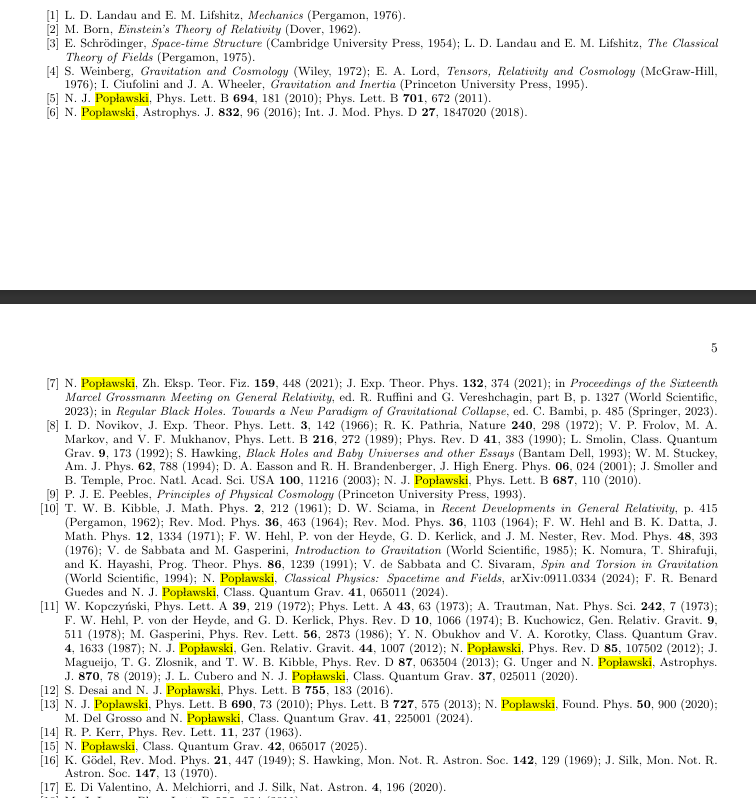

Just 15! Much better!
I rate this paper torsion/thin air.
There have been a few other papers written on this topic this year, but they run into the same problems, so there isn’t much point in discussing them individually.
Conclusion
I really wanted this to be true! I really did! Neil deGrasse Tyson talked about this idea favorably, and even Sabine Hossenfelder didn’t give it a high grade on the “Bachelors of Science” meter and she sure loves doing that. For a minute I really thought we were cooking. I mean, come on: “Our universe is inside a black hole.” How cool does that sound?! And the math...oh, the math - it’s so ✨ elegant ✨ and pretty, you almost want to...pet it, squish- DON’T SQUISH the universe math!
But then physics did what physics does best: it ruined the fun. No matter how shiny the equations look, the universe just refuses to cooperate. We currently have no definitive observational evidence for this idea. Normally, I love to fence-sit in my conclusions, but you know what, I’m telling you now, I don’t think this will turn out to be correct. If Black Hole Cosmology were true, there are too many things we should be able to detect pretty easily and we just don’t.
So, I’m sorry, BHC fans, all three of you, but my extremely unprofessional verdict is that reality probably went with some other option. In the meantime, remember: you really shouldn’t be getting your physics opinions from a biologist…but here you are, and honestly, it probably means it’s time to stop looking into black holes and go touch some grass.
Euralēthia
Subscribe to the newsletter
Get updates on new posts, projects, and occasional thoughts and reflections! Basically, whatever's on my mind straight to your inbox.