
What Is „Truth“ Anyway?
What does it mean for something to be true? Many philosophical theories have tried to answer this question, each offering a different perspective.
WHAT THE HECK?


Today we’re talking about Truth! What even is Truth? Sounds like an incredibly stupid question. „If you don’t even know what truth is, why in the phoque, pardon my French, are you writing blog articles?“ you might say.
And sure, we all know what it is...intuitively. But have you ever tried to actually verbally formulate what it is that makes statements true? I tried and I couldn’t do it without immediately noticing some glaring flaw in my logic. Every definition I tried ran into problems as soon as I examined it closely and tested for consistency.
Once such a simple, intuitive concept, disolved right in front of my eyes the moment I thought about it for more than 5 minutes. Am I...stupid? As it turns out, probably not, or we all are, because not even the greatest of minds can agree on what the concept of truth actually entails.
Yeah, this thing you and I spent about an hour puzzling over is a question philosophers have been trying to solve for millennia. So, let’s see if they had any brighter ideas than us two (probably not)...
Different philosophical theories of truth
Correspondence Theory


A statement is true if it corresponds to the way the world actually is. In other words, truth is a relation between propositions and facts (reality). If I say, “The cat is on the mat,” and we check and the cat is indeed on the mat, my statement is true.
Seems about right, right? As it turns out, philosophers have managed to make virtually every component of this seemingly simple definition an utterly unsolvable mystery (adverb, adjective, noun). What does it mean “to correspond”? What is “a fact”? Which things are parts of “reality”, and which ones are not? I’m sure this sounds like pointless semantics, of course everyone knows what a “fact” is! But it’s actually not so simple and that right there is very concerning. When we stop to think about what the words we use every day actually mean, we quickly discover… what it’s like to have an existential crisis.
Take the word “correspond” for example, simple word. A map can correspond to a territory. A model corresponds to what it models. But when we use it to talk about statements or beliefs we are talking metaphorically. What does it literally mean for a mental or linguistic item to line up with a chunk of reality? It’s like saying “The color blue corresponds to the cat on the mat”. No one can tell you in any non-poetic terms what this correspondence, or lack thereof, actually consists of.
What is a fact? A physical state of affairs? An abstract thing? A true sentence? Philosophers don’t really agree. Us laypeople, mostly do and we say “A fact is simply how the world is. A fact is the reality of the situation”. Look at us being smarter than philosophers. But then they hit us with “But what is reality?” At that point, laypeople reach for very real stones...to hit back.
But truly, is reality independent of the mind? If so, how could we ever know it, since we only perceive it through the mind? Is it a physical thing, or social, or biological? For example, “Money exists” is true socially but false in physical reality. It’s just paper, or worse, a bunch of numbers assigned to a card. So, what in the world are we even talking about?
And what about mathematical, moral or modal claims? Is it true that 2+2 =4? What in the world is a “two”? Does “Murder is wrong” correspond to something real in the universe? And “I could have (or should have) been a doctor” ...how the heck would we check that?
I don’t know about you, but it feels like all words just lost their meanings at once.
Coherence Theory


A belief is true if it fits coherently within a system of beliefs. Truth, in this view, isn’t about matching some independent reality. It’s about consistency and logical harmony inside a web of beliefs. Instead of asking “Does this statement correspond to reality?” coherence theory asks “Does this belief make sense given everything else we already believe?”
So, if I hear a “Meow” from the direction of the mat, if I hear the sound of the mat being scratched, and if I know I have only one cat, I can conclude: “The cat is on the mat.”
This is awesome! It’s how science, ethics, math, logic, and metaphysics work (to an extent). It avoids a lot of the problems of correspondence theory. But it also has its own problems…
Mainly, what if this goober isn’t on the mat after all? You could have all the clues you want, but if the cat simply decides not to be on the mat you could beg, plead, show how beautifully logical your deduction and induction were and the cat will yawn at you from the comforts of a...BOX! It’s always the stupid box and NOT the mat! “This doesn’t make any sense!” you could say “Have you no respect for the theory of truth, Mr. Whiskers?!”
And then you will face humiliation for the rest of your life for thinking “the cat was on the mat”. Or for thinking it was “the correct bus”, you can stop talking about it, boyfriend of mine.
Coherence theory walks the line between truth and justification. What it really explains well is why we are justified in believing something. But justification ≠ truth. A belief can be well-justified, coherent with everything else we believe and rational to hold and still it could be the wrong bus, dammit!
Another problem is that multiple coherent systems can exist, all internally consistent and elegant. But if truth equals coherence, which one is true? Coherence alone can’t decide and because of this we clearly see that it cannot guarantee the contact with reality.
If you want to inspire Mr. Whiskers to finally grace the mat with his presence, or just want more ramblings about philosophy, consider subscribing to the newsletter. It’s absolutely free, but means a lot to...Mr. Whiskers. You wouldn’t disappoint a cute lil kitty, would you?
Subscribe to the newsletter
Get updates on new posts, projects, and occasional thoughts and reflections! Basically, whatever's on my mind straight to your inbox.
Pragmatic Theory


Now here we’ll present multiple philosophers with slightly different ideas.
Peirce basically says “Look at these plebs! They’ll believe pretty much anything.” And he’s right, we do. Many of our ways of forming beliefs, whether conscious or subconscious, don’t really care whether those beliefs are actually true. Monkey brain wants comfort and usefulness. So, the real question becomes: what distinguishes beliefs that actually track reality from beliefs that merely feel convincing?
Well, any belief we currently hold could be wrong, but Peirce doesn’t think this means inquiry is pointless. Science works, we correct errors, refine theories, and learn new things. So, truth must be something that’s independent of what anyone happens to believe right now, yet still something we can get closer to, despite our fallibility.
With that in mind, we come to his central idea: A belief is true if it’s what inquiry would eventually settle on (what all investigators would agree on) if inquiry were carried on indefinitely, under ideal conditions. In other words, truth is what reality would force us to believe in the long run, whether we like it or not. It’s whatever stubbornly survives every attempt to doubt or test it. On this view, truth is like infinity: never fully reached, but still real and giving inquiry its direction.
Now, I don’t think Peirce ever met a Young Earth Creationist or a flat-earther, because those types just immediately disprove his theory. They are like cats. You can show a cat a million and one reasons why the mat is objectively better, across the infinite amount of time and it will still choose the stupid box every time. Cats and flats aside, I make a good point, if I may say so myself. Why should we assume the eventual convergence at all? I mean, that’s a pretty big assumption to make and I don’t think it, at all, considers the infinity of human stupidity.
Or how do we tell the difference between approaching truth and moving around inside an elaborate maze of nonsense? If truth is never actually reached, does it exist at all, or is it just another nice, comforting story we tell ourselves?
Peirce’s view relies on some pretty serious metaphysical commitments, a metaphysical marriage if you will. The world has to have stable regularities and enough structure to force eventual agreement, yet there’s no proof that this is actually the case.
James has a slightly different take. He basically says that a belief is true as long as it’s backed up by experience and keeps “working” within our overall experience. So, verification is ongoing, truth is temporal and beliefs can become false later on.
Do I even need to explain why this is problematic? It grants some beliefs a status of “true until proven false,” which just isn’t how truth seeking is supposed to work. Plus, how long does a belief have to work before we call it true? 5 years? 10? A lifetime? What if a belief works fine for 10 years, then fails catastrophically? James would still say it was true during those 10 years, but that, in my experience, just seems wrong.
Finally, we get to Dewey, who thought both Peirce and James were basically talking nonsense. This thing they call “Truth,” is but a philosophical distraction. What actually happens is much simpler: problems come up, we find solutions, certain claims end up being warranted. So, Dewey drops truth altogether and replaces it with “warranted assertibility.”
A claim is warrantably assertible if it solves the problem that generated inquiry, results from controlled investigation, integrates evidence and remains undefeated by criticism. There is no appeal to final truth and everything is always open to revision.
Well, that’s like solving a headache by cutting your head off. This is barely a theory of truth, it’s a theory of justification. It tells us why we might be justified in believing something, but says pretty much nothing about truth itself. It also doesn’t escape the same problem James had. If we spent 10 years warrantably asserting some view and it later turns out to be wrong, then it was never true in the first place.
Deflationary Theory


This one was the most difficult for me to grasp because it rejects some assumptions about truth we usually take for granted, like the idea that truth explains something. We often think that truth tells us why we should accept a certain claim or what makes it correct. Deflationism disagrees.
According to the deflationary theory, truth is not a single, substantive, or explanatory property. There is no mystical feature that all true statements share. It doesn’t explain why certain beliefs are successful and doesn’t tell us how language connects to reality. So far, sounds like an absolutely useless and pointless theory. So, spit it out, what is Truth then?
P is true if and only if P.
Everything that can be said about truth can be summarized in this statement......Wot?
“Snow is white” is true if and only if snow is white.
“Cats are cute” is true if and only if cats are cute.
At this point, you might object: “But how do we know whether cats are cute? And what does ‘cute’ even mean?”... By what ruin of judgment does a mind arrive at such question? What dark corruption of the soul renders a person incapable of distinguishing the cute from the non-cute, the blessed from the unforgivable? Which demon has taken residence in your reason that you now stand before me, eyes open, heart hardened, and deny the obvious? No, they’re not cute, they’re gremlins!
But even if we entertained such questions, the deflationists would say that they’re not about truth. Those questions are about evidence, concepts, psychology, biology, or personal taste. Truth doesn’t help us determine whether a particular claim is correct; it merely states the conditions under which it would be. The task of figuring it out belongs to other areas of inquiry.
Saying that a statement is true does not add anything to the statement itself. “Snow is white” and “Snow is white is true” assert the same thing about the world. Truth is often just a practical linguistic device. It allows us to endorse and generalize without committing to any metaphysical theory. Its role is simply to make generalizations like “What she said is true” or “Everything in the report is true” intelligible and usable.
This is why the theory is called deflationary. It deflates all those pompous ideas about truth being some metaphysical property and simplifies the whole thing with “P is true if and only if P”. Simple and beautiful.
If we have two people arguing about whether snow is white, they will both agree that the statement “snow is white” is true if and only if snow is white. So, they agree on what constitutes truth. Where they might disagree is how we verify that snow is white, but that now is a problem of verification, not truth.
So, where’s the catch? What doesn’t work here?
Truth Pluralism


We humans love big, elegant theories. One explanation to rule them all. One account of truth and objectivity that works for everything. Pluralists say “That’s just not realistic. The reason why we can’t find one standard of truth for mathematical, ethical and scientific claims is maybe because there isn’t one.”
Basically, Truth Pluralism is the idea that there’s more than one legitimate way for statements to be true, depending on what we’re talking about. Science, math, art, ethics, these are all different disciplines and they are governed by different rules.
When we talk about science, we should evaluate claims based on empirical evidence and predictive success. If a theory predicts the wrong thing, it’s just wrong, plain and simple. Here, correspondence to the physical world really matters.
In mathematics, on the other hand, claims aren’t tested with experiments. They’re evaluated through logical consistency, and coherence with axiomatic systems. A mathematical truth doesn’t become false because a lab experiment went wrong.
In ethics we assess moral claims through the lens of values, principles and human practices. We don’t run experiments in order to prove the superiority of one or another moral system.
And so, we shouldn’t try to make things into something they are not. Different areas of discourse, quite evidently, require different standards of correctness, and no single theory captures them all. And that is okay, we should learn to accept that.
But of course, there are also problems with this theory.
First of all, who decided the standards? Was God there when we agreed to judge scientific claims based on empirical evidence and moral claims based on our values? What if I want to discern scientific truths based on my natal chart? Who’s gonna stop me?! I want to speak to the CEO of knowledge!
If a statement is true because it meets the standards of its discipline, then we need an explanation of why those standards have the authority to generate truth in the first place. Otherwise, “truth” starts to sound less like something objective and more like whatever the relevant group of professionals happens to approve of.
Also, this all seems to work only when topics stay nicely separated. What about the questions such as “Is it morally wrong to ignore scientific facts about vaccines?” This question doesn’t deal purely with science or morality. So how am I supposed to judge its truthfulness? Based on empirical evidence? Moral reasoning? Logical coherence? My natal chart?
And, mind you, these mixed questions aren’t outliers, they’re everywhere. Climate change, medical policy, economic justice, AI safety etc. etc. Truth pluralism has no answer for these cases. If different truth standards apply at the same time, what happens when they pull in different directions?
Also, if you’re turning to truth pluralism because you’re dissatisfied with the other theories, I have some news for you. Now you have the problems of all the previous theories! You get to truths about science through empirical evidence? Oops, that’s correspondence theory! Want to know truths about ethics? Oops that’s coherence or pragmatism or both! No problems were escaped in the making of this theory!
And perhaps the most fundamental objection: If truth works differently in different disciplines, what even is "truth" anymore? So, scientific statements are true in one way, mathematical statements in another, and moral statements in yet another. What do all these “truths” actually have in common? Pluralists might say “Nothing, that’s the whole point!” But that’s just problematic.
If truth really means something radically different in every domain, then it’s hard to see how we’re still talking about one thing at all. Instead, it seems that we have a bunch of disconnected ideas we’ve slapped the label of “truth” on while quietly hoping no one would notice.
As we previously said, deflationists believe that truth doesn’t really explain anything. On their view, calling a sentence “true” doesn’t add any new information, it’s just a convenient way of agreeing with the sentence itself. But critics argue that even deflationists can’t fully avoid giving truth an explanatory role.
Whether a sentence is true depends on two things what the words of that sentence mean and how the world actually is. For example, “snow is white.” It wouldn’t be true if we had defined “snow” to mean grass, or if by “white” we meant the color black. It also wouldn’t be true if, in reality, snow weren’t white. So, the truth of the sentence depends both on language and on the world.
Once you admit this kind of dependence, it becomes harder to say that truth does no explanatory work. Explaining something often just means showing what it depends on.
Deflationists say: “Snow is white” is true if and only if snow is white. This tells us when the sentence is true, but also, implicitly, why it’s true. “Snow is white” is true because snow is white.
Makes sense, right? If the truth of a sentence depends on how the world is, then it looks like the world explains why the sentence is true. At this point, deflationists push back and say that this goes too far. They insist that saying “ ‘P’ is true” is just another way of saying “P.” But if that’s so, the sentence collapses into circular nonsense.
Snow is white because snow is white.
And that’s no explanation at all. Something can’t explain itself.
So, the main problem is that deflationists want us to believe that truth does no explanatory work, while still saying that our sentences are correct or incorrect depending on how the world is. This tracking of the world already looks like an explanatory role. Once you admit that (keeping the meanings of the words the same) the truth of a sentence changes depending on how the world is, you’ve effectively admitted that facts about the world are what determine whether sentences are true, even if you refuse to describe it that way. And this looks a whole lot like correspondence theory in a trench coat.
Deflationists also say that one of the main purposes of the word “true” is to help us make general claims. For example, it lets us say “Everything she said is true” without having to list every single thing she said. But critics think there’s an irony here. Deflationism explains truth one sentence at a time, but it struggles to explain general facts about truth.
According to deflationism, the whole theory of truth is built out of individual equivalences like “P is true if and only if P.” “Q is true if and only if Q.” etc. But listing individual cases, even infinitely many of them, doesn’t explain why general claims about truth are correct. For exmple
“All logical truths are true.” This isn’t just a long list of individual cases. It’s a general statement about a whole class of sentences.
Imagine trying to explain why all ravens are black by saying: “This raven is black. That raven is black. That raven over there is certainly black...” Apart from the fact that you’d run out of sanity before you run out of ravens, even an infinite list wouldn’t explain the fact that being a raven evidently implies being black. Why does this implication exist? The general statements seem to say something more than each individual case taken on its own.
Deflationism can give us every individual instance of truth, but it can’t explain why broad claims about truth are correct in the first place. And if a theory of truth can’t account for these everyday general claims, then it fails to capture our full understanding of the concept of truth
Final thoughts
Having looked at all these theories are we any wiser? Depends on what you mean by “wiser”. Are we any closer to figuring out what Truth is? Nope. Are we any closer to being admitted into a mental institution? Increasingly so. But!
I do believe these kinds of mental exercises help us understand the world better, mainly by exposing how little we truly know about it. They force us to confront the fact that many things we treat as obvious or self-evident are, on closer inspection, incredibly complex.
It’s like looking at a painting you’ve seen many times before: a farmer plowing his field, the mountains cradling the sea as the ships calmly glide across the waters. Then suddenly… is that smudge in the background a man drowning?! Has that been there the whole time?! Yes, that is a real painting, btw!
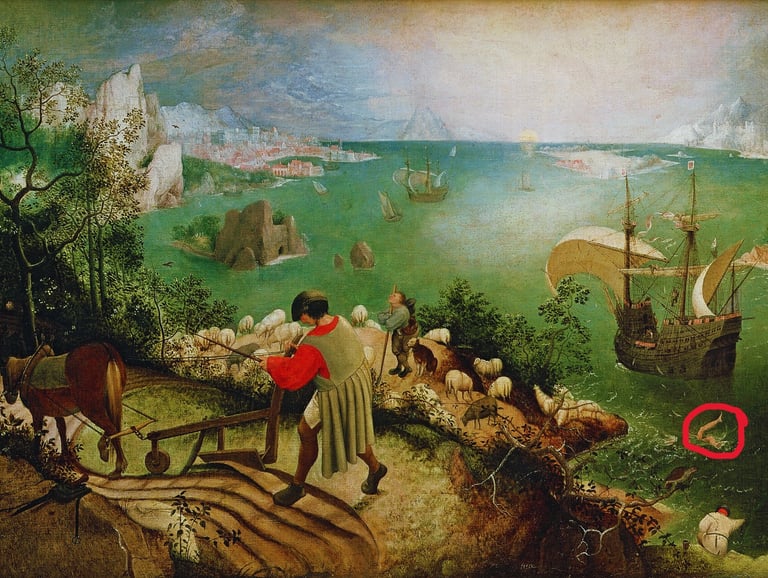
Landscape with the Fall of Icarus by Pieter Bruegel the Elder. Icarus circled in red.
Or, perhaps an even better metaphor, two distinguished gentlemen standing confidently among globes and instruments, symbols of knowledge and reason. Everything suggests that the world is, in principle, legible, under control, and ohhhh my God, that’s a skull! That’s just been chillin there the whole time. Okay, then! Also, a real painting.
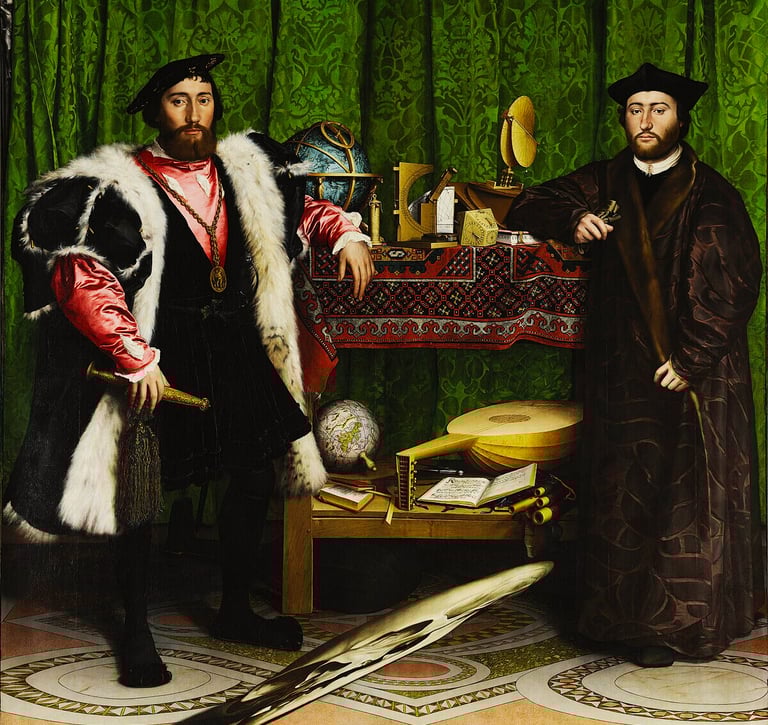
The Ambassadors by Hans Holbein the Younger. I’m not going to circle the skull.
Yes, one is by “the Elder” and the other by “the Younger”, hah. Pure coincidence.
But I digress, the point is the truth about truth is that we don’t know the truth of it. This can push us in several directions.
We can become truth nihilists. Maybe there is no such thing as truth at all. In the non-ironic, yes-iconic words of one of my nihilist friends: “F reality, magic is real.” Statements like “snow is white” aren’t true or false in any objective sense. “Truth” is just a convenient label we slap onto things we like or agree with.
We might turn into a skeptic and simply say that truth exists, but we lack sufficient justification to know which statements are true, or perhaps to know any truths at all.
Or we could just go “ayy, fuhgeddaboudit!” Who cares about this anyway? I’ll call “truth” what I call “truth” and it’s good enough for me because I know I’m right! I call this one Fuhgeddaboutism – the utter lack of phoques to give about the question itself. Or about making the same joke twice. Or about there maybe existing a more sophisticated name for this kind of stance. Ah, fuhgeddaboudit!
Most people, myself included, will probably come out of this with stubborn, utterly undeserved optimism. Oh, we just haven’t figured it out yet! Of course there’s truth, of course there’s a way to know something is true. We just need to, like…get ourselves together and figure it out, okay? And okay it is, because that’s the best we can do for now.
And if I’ve learned anything from therapy and motivational instagram quotes, it’s that they are equally effective at treating mental illness, wait, no, it’s that sometimes the best we can do really is good enough.
Euralēthia
Subscribe to the newsletter
Get updates on new posts, projects, and occasional thoughts and reflections! Basically, whatever's on my mind straight to your inbox.